

Explore industrial 3D printing with Multi Jet Fusion (MJF) and Fused Deposition Modeling (FDM). Learn efficiencies, material choices, and deployment strategies.
Author Archives: Martha
Uncategorized
Revolutionizing Local Industries: How Additive Manufacturing is Changing the Game in North Vancouver

In North Vancouver, a quiet revolution is unfolding in the heart of our local industries. At Upsurge, we’re not just participating in this revolution; we’re leading it with cutting-edge additive manufacturing technologies, including HP MJF for medium-run production and FDM machines geared for creating functional parts. This transformative approach is not only optimizing production cycles but is also exponentially increasing efficiency across various sectors within Vancouver and broader Western Canada.

As the world of manufacturing evolves, North Vancouver has become a hub for innovation, particularly in the field of product development. Companies are increasingly relying on advanced manufacturing techniques like 3D printing, additive manufacturing, and robust product design to stay competitive. In this context, implementing innovative product development strategies is not just beneficial; it’s imperative for success.
Uncategorized
Revolutionizing the Manufacturing Landscape in Western Canada with Advanced 3D Technologies
In the heart of North Vancouver, a quiet revolution is unfolding that’s set to redefine manufacturing dynamics not just locally, but across Western Canada. At the forefront of this industrial transformation is the increasingly integral role of additive manufacturing, product development, and 3D design. Here, at Upsurge, our commitment to leveraging cutting-edge technologies like HP Multi Jet Fusion (MJF) and Fused Deposition Modeling (FDM) underpins the substantial strides we are making in manufacturing precision parts and prototypes.
In the bustling workshops of North Vancouver, a quiet revolution is taking shape, altering the very fabric of how products are designed, developed, and delivered. At the forefront, additive manufacturing, or as it’s more commonly known, 3D printing, is not just an alternative process but a transformative one for manufacturing sectors across Western Canada. Here […]
Here in North Vancouver, the manufacturing sector is experiencing a significant transformation, thanks to the integration of advanced technologies like 3D printing and additive manufacturing. At the heart of this transformation is a drive toward greater efficiency, customization, and reduced waste, principles that are crucial in a world where precision and sustainability are becoming increasingly […]
For decades, many British Columbia companies relied on overseas suppliers or distant manufacturers to produce their parts. It worked—until it didn’t. Long lead times, high shipping costs, and unpredictable delays have forced Vancouver businesses to rethink how they source and manufacture critical components.
Now, a quiet shift is happening. Local additive manufacturing is transforming the way BC companies design, test, and produce parts.
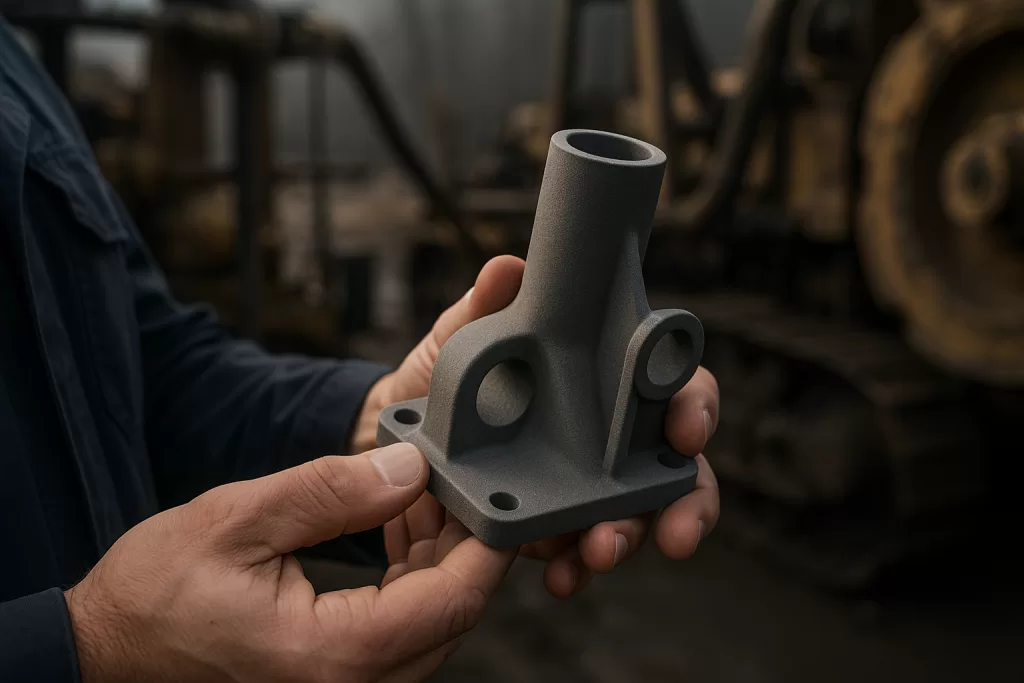
For decades, manufacturers have been locked into a cycle of expensive tooling, long production runs, and inflexible design changes. If a company needed a new part, the process could take months and eat up a massive chunk of budget before a single usable unit rolled off the line. That reality is changing. Today, custom industrial 3D printing has matured far beyond its prototyping roots. Businesses across industries are discovering that additive manufacturing is not only faster but also more cost-effective for production-ready parts.

At the intersection of cutting-edge innovation and community impact, we caught up with Fardin Barekat, Research Associate at BCIT’s Center for Applied Research and Innovation, to talk about the evolving world of 3D printing, his side ventures, and what technologies like Multi Jet Fusion (MJF) mean for the future of design and manufacturing.

The impact of HP MJF technology on eco-friendly product development is evident in numerous industries. In the automotive sector, several manufacturers have leveraged MJF to produce lightweight and durable components, improving fuel efficiency and reducing emissions.