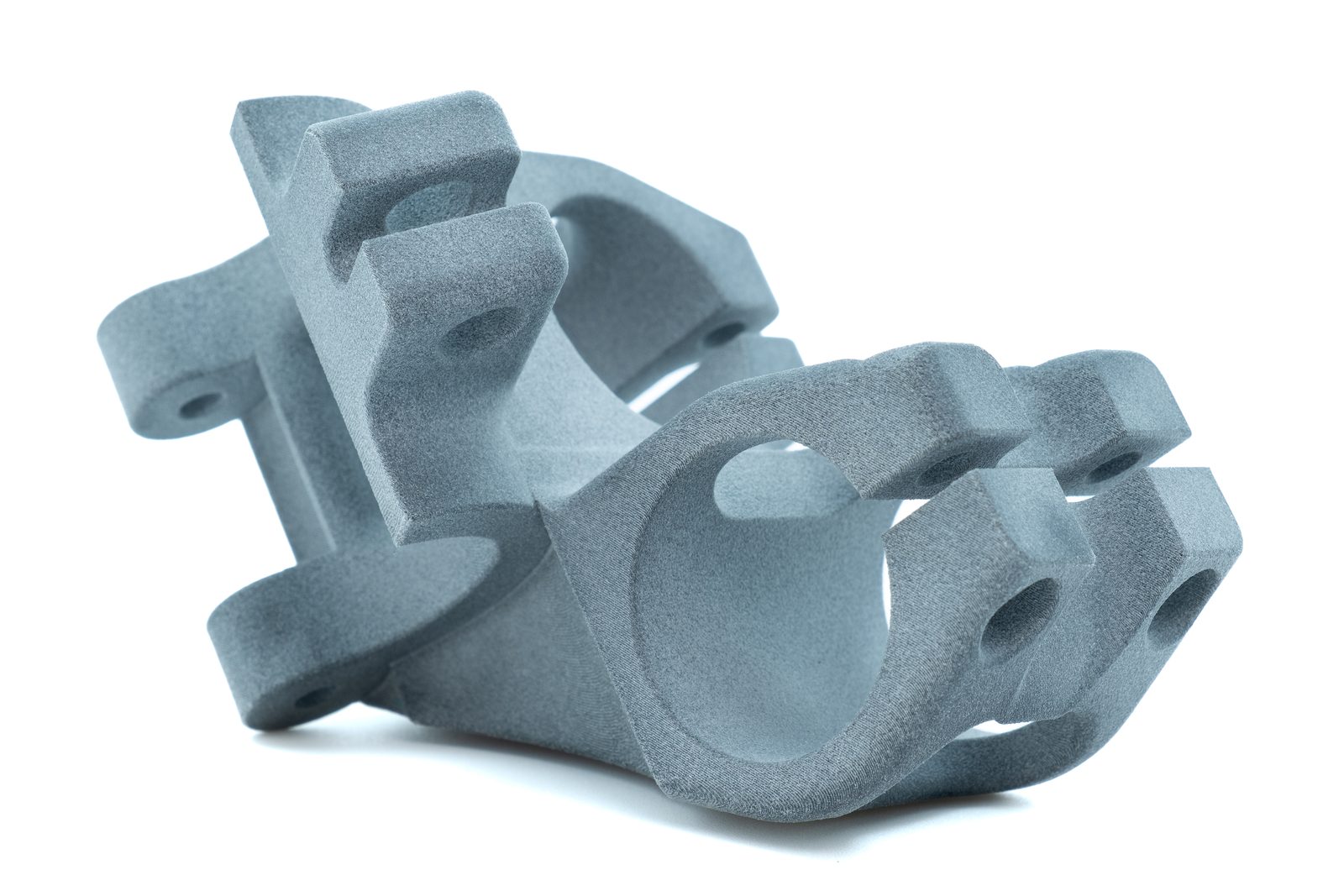
MJF 3D printing takes your part from the first prototype to large production batches. HP Multi Jet Fusion was made for complex geometries, demanding applications, and watertight parts, and it builds them the same way every time.
AT A GLANCE
Standard lead time. Rush and Economy are on the quote.
Build envelope (15 × 11.2 × 15 in). Anything that fits comes out as one piece.
One part or a full build.
Layer thickness (0.003 in).
THE PROCESS
MJF 3D printing, or HP Multi Jet Fusion, builds parts from PA12 nylon powder one layer at a time. A printhead array jets fusing agent where the part forms and detailing agent along its contours, and infrared energy fuses only the treated powder. The rest stays powder, so parts build without support structures.
That unfused powder does the holding, which is why MJF prints geometry other processes have to be talked into: undercuts, internal channels, and assemblies that come out already assembled. Interlocking and moving parts need a minimum 0.7 mm (0.028 in) gap between faces to stay free. Anything bigger than the build gets split at a chosen seam and bonded afterward, and splitting is worth considering even when the part fits, because a large boxy part broken into subcomponents can raise how many run per build by more than half.
Tensile strength and modulus land at 48 MPa (6,960 psi) and 1,800 MPa (261 ksi) in both XY and Z. Elongation is the one that moves: 20% in XY against 15% in Z. If the part flexes, orientation is a design decision rather than a scheduling one.
Straight off the machine, with no sealing or coating.
Electronics housings, enclosures, mechanical assemblies, jigs, and fixtures all ask for three things: fine detail, complex shapes, and the durability to get through daily use. That's the ground MJF printing was built for. Where most additive processes are built around the one-off prototype, MJF was designed to fill a build with production-ready parts, and HP sells the 5200 as a machine for mid-volume production.
PA12 on MJF comes off the machine watertight, with no sealing and no coating. What it holds depends on the wall, the shape, the temperature, and the fluid. In HP's short-term tests with water at 25°C (77°F), a 2.5 mm (0.098 in) wall stayed tight at 10 bar (145 psi) and a 4 mm (0.157 in) wall at 20 bar (290 psi), and spheres and cylinders took pressures that broke cubes. If the part carries fluid, round it out and give it wall.
It also holds up against most of the fluids a part meets in service. Motor oil, unleaded petrol, and DOT 3 brake fluid had no effect in HP's tests, while hot water and chlorinated hydrocarbons had a moderate one. The full list of 16 fluids is on the PA12 page.
Full chemical and thermal data: PA12 nylon ↗MATERIAL
HP engineered this PA12 for Multi Jet Fusion, and it does the work of two materials. It's stiff enough to carry load in a bracket and gives enough to take a snap fit without cracking, which is one of the reasons it's among the most widely used engineering plastics in 3D printing. It builds functional prototypes and end-use parts, from complex assemblies and watertight housings to brackets, clips, and tooling.
Reused powder in every build, so less material ends up as waste.
Because it carries load and still flexes, PA12 3D printing on MJF shows up in:

A hardware startup needed 300 enclosure components with an injection-mold finish for a retail product launch. Tooling would have pushed the timeline past their funding window. We delivered PA12 parts printed on MJF, black dyed, and shot peened. Surface finish matched their reference injection-molded sample. First batch shipped before their launch deadline. They've since ordered components for two additional product lines through the same process. — Product Development Lead, Consumer Electronics
An autonomous systems company was iterating on a sensor housing that needed to survive sustained vibration and outdoor temperature swings. Their stereolithography (SLA) prototypes cracked after thermal cycling. We delivered PA12 on MJF, with a heat deflection temperature (HDT) of 175°C (347°F) at 0.45 MPa (66 psi) and 95°C (203°F) at 1.82 MPa (264 psi), and impact strength that handles vibration without fatigue cracking. The housing passed their environmental validation on the first batch. They now run recurring production with us. — Mechanical Engineer, Autonomous Systems
A medical device company needed custom orthotic components, each one unique to the patient. Traditional manufacturing couldn't deliver per-patient geometry at a cost that made business sense. We delivered PA12 nylon, USP Class I-VI biocompatible, printed in batches of 50+ unique geometries per build. No tooling per patient. DFM review caught two wall-thickness issues before production. Every part met their dimensional requirements. — R&D Manager, Medical Devices
An automotive supplier needed 200 custom jig fixtures for a production line changeover, and needed them faster than their CNC vendor could deliver. We delivered functional PA12 jigs with mounting holes held to ±0.2 mm (0.008 in). Printed, tumbled, delivered. The fixtures have been in daily use on the production floor without replacement. — Mechanical Engineer, Automotive
SCALING UP
With HP Multi Jet Fusion, the part you test as a prototype is the part you produce. The process, the material, and the properties stay the same, so there's nothing to redesign or requalify when you scale up on MJF, and one part and 300 start from the same place.
MJF printing fuses an entire layer at once instead of tracing each part point by point, so build time depends on height, not on how complex the geometry is. Many parts get packed into a single build, so small batches and repeat orders move quickly from file to finished part.
Every build runs on the same file, the same print parameters, and the same PA12 powder, refreshed at the ratio HP specifies for stable performance. The material carries production-level certifications too, including USP Class I-VI, RoHS, REACH, and UL 94 HB.
Injection molding is the right destination for high-volume parts. The question is when to commit to it. A mold is a large, upfront investment made before the market has said a word about your product, and once it's cut, every design change costs time and money. MJF lets you get to market first and commit to tooling once the numbers justify it.
There's no mold to design, cut, or approve. Your parts go from final file to production-grade PA12 while a tooling program would still be in its first rounds of review. That means your product reaches customers, investors, and distributors sooner, and your delivery date is set the day you place the order.
A prototype that looks right is not the same as a product that works in the field. With MJF, the first parts you put in customers' hands are already production parts, so your proof of concept is built on real performance data from real users, not on assumptions.
Early sales, pilot customers, and repeat orders are what convince investors and justify a mold. MJF lets you produce and sell in the quantities your market actually demands today, and our pricing drops as your volumes grow. Injection molding will always win at very high volumes, but by the time you reach them, you'll have the traction and the revenue to fund the tool with confidence.
A mold locks your design and your capital into a single version of your product. If customers ask for a change, or demand grows slower than planned, that investment is stuck. With MJF, every design change is a new file, not a new tool, and your cash stays available for the business instead of sitting in steel.
HP doesn't hand out a single tolerance for the whole process. It measured PA12 on this machine across the full build, and the answer depends on size and axis: small features hold tightest, and Z always runs a little looser than XY. Parts that fit together need a 0.4 mm (0.016 in) gap, and long, thin parts can pull off their nominal shape as they cool, so thicken the long walls or lighten the part.
XY tolerance on features up to 30 mm, measured by HP at Cpk 1.33. (0.010 in)
Z tolerance on the same features. (0.017 in)
| Spec | Value |
|---|---|
| Build envelope | 380 × 284 × 380 mm(15 × 11.2 × 15 in) |
| Layer thickness | 0.08 mm(0.003 in) |
| Minimum wall, short walls in XY | 0.3 mm(0.012 in) |
| Minimum wall, short walls in Z | 0.5 mm(0.020 in) |
| Minimum wall, hollowed parts | 2 mm(0.079 in) |
| Gap between connecting parts | 0.4 mm (0.016 in), ±0.2 mm (0.008 in) per part |
| Clearance between moving faces, printed assembled | 0.7 mm(0.028 in) |
| Length-to-width ratio before warpage risk | 10:1 |
| Material | PA12 nylon |
Every finish runs in our North Vancouver facility, under the same process control as the build, so results stay consistent from part to part.
FAQ
Short walls can go down to 0.3 mm (0.012 in) in XY and 0.5 mm (0.020 in) in Z. Hollowed parts are a different story: give them at least 2 mm (0.079 in) of wall, and more if they carry load, since thicker walls bring higher mechanical properties. Anything under the minimum gets flagged in the DFM review before the build.
Yes. PA12 on MJF gives you the same tensile strength and stiffness in every direction, holds water without a coating, and carries production-level certifications, which is why it goes straight into housings, enclosures, assemblies, and fixtures. The real test is your part's own loads and temperatures, and the PA12 page has the full numbers to check them against.
Standard is five business days. If the launch can't wait, Rush takes three, and if the date has room, Economy takes 10. You pick the option on the quote, so the date you plan around is the one you chose.
Yes. We regularly work under NDA and are happy to sign yours before you share a single file. Send it through RFI / RFQ help with a line about the project, and your CAD stays on your side until the paperwork is done.
Our MJF 3D printing service quotes straight from the CAD. Upload STEP, STL, IGES, or 3MF and get an Instant Quote, or use RFI / RFQ help if the job needs a conversation before a price.